Oceania · Culture
Kuma (Wahgi Valley)
Kuma, of the middle Wahgi
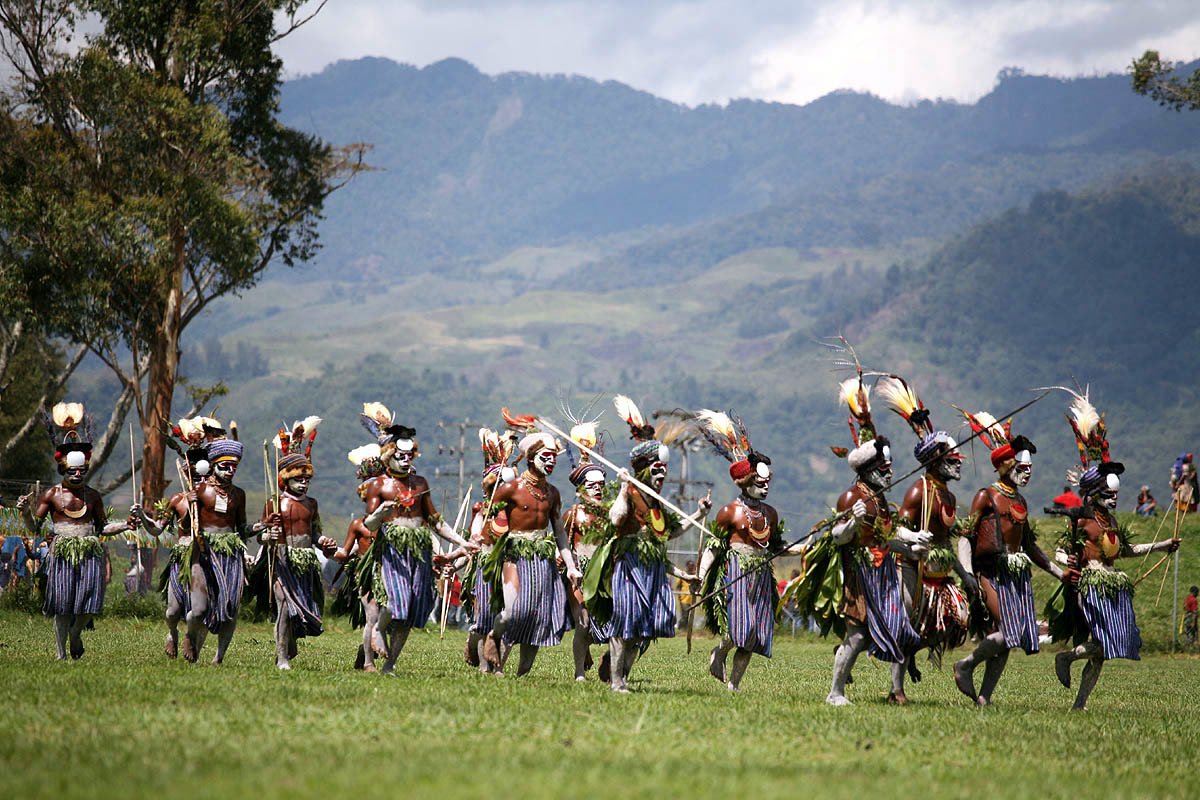
Highlanders at the Mount Hagen cultural show, in the Western Highlands near the Wahgi Valley — the region of the Kuma. — Photo: Jialiang Gao (peace-on-earth.org) · CC BY-SA 3.0 · Source
The mushroom that may not be a drug
Among the Kuma of the middle Wahgi Valley in the New Guinea Highlands, the anthropologist Marie Reay documented, in 1960, a startling seasonal phenomenon she called “mushroom madness” (komugl tai): men and women who, after eating certain wild mushrooms, would shake, shout, brandish weapons, and career through the settlement in a temporary frenzy before returning to themselves.1
The investigation that found nothing
Because this looked like a spectacular Old-World entheogen, Roger Heim and R. Gordon Wasson mounted an expedition to run it down. They identified the mushrooms involved — the nonda boletes, including the vivid Boletus manicus — but, crucially, could not demonstrate any compound that would produce the behaviour.2 The pharmacology simply wasn’t there in the way the story implied.
Why it belongs — as a warning
Many scholars now read the Kuma “madness” as a culturally patterned performance — a sanctioned window in which people could behave in ways otherwise forbidden — that happens to be attributed to mushrooms rather than caused by them. That is exactly why it belongs in this archive: as the classic reminder that a “mushroom tradition” is not always a pharmacological one, and that the honest label here is disputed.
Footnotes
The record
Names of the mushroom
| Name | Language | Translation / gloss |
|---|---|---|
| komugl tai / nonda (various boletes and russulas) † | Kuma | — |
Indigenous- and local-language names appear in many spellings across dialects, publications, and orthographies. We record them as given in our sources and do not standardise them or invent translations. A dagger (†) marks a form our sources flag as uncertain.
Historical record
- 1960
Reay's 'mushroom madness'
The anthropologist Marie Reay describes komugl tai — seasonal episodes in which Kuma men and women behaved wildly, said to follow the eating of certain mushrooms.
Contemporary ethnography - 1965
Heim and Wasson investigate
Roger Heim and R. Gordon Wasson identify the nonda boletes (including Boletus manicus) but find no compound that would explain the reported frenzy.
Botanical / mycological
Evidence
The support for this entry, separated by kind. Different kinds of evidence carry different weight.
- Contemporary ethnography
- Reay, 'Mushroom madness in the New Guinea Highlands' (1960).
- Botanical / mycological
- Heim & Wasson, La folie des Kuma (1965) — species identified, psychoactivity not confirmed.
What remains uncertain
- The central question — whether the mushrooms cause the behaviour at all — was never resolved; the 'madness' may be a culturally sanctioned social performance.
Sources & editorial record
Sources & further reading
Marie Reay (1960). Mushroom madness in the New Guinea Highlands. Oceania 31(2): 137–139.
Classic ethnographic report of "komugl tai" / nonda-associated behaviour among the Kuma of the Wahgi Valley, Papua New Guinea — the anthropological origin of the puzzle.
Roger Heim & R. Gordon Wasson (1965). La folie des Kuma: le champignon nonda et Boletus manicus. Cahiers du Pacifique.
Heim and Wasson investigate the New Guinea "mushroom madness," identifying nonda boletes (including Boletus manicus) without isolating a compound that explains the reported effects.
Andy Letcher (2006). Shroom: A Cultural History of the Magic Mushroom. Faber & Faber.
A critical cultural history that deflates several popular entheogenic myths — useful precisely where it disagrees with the psychedelic canon.
Editorial record
Corrections history
No corrections recorded yet. Spotted an error or a mischaracterisation? See how corrections work.
Last reviewed