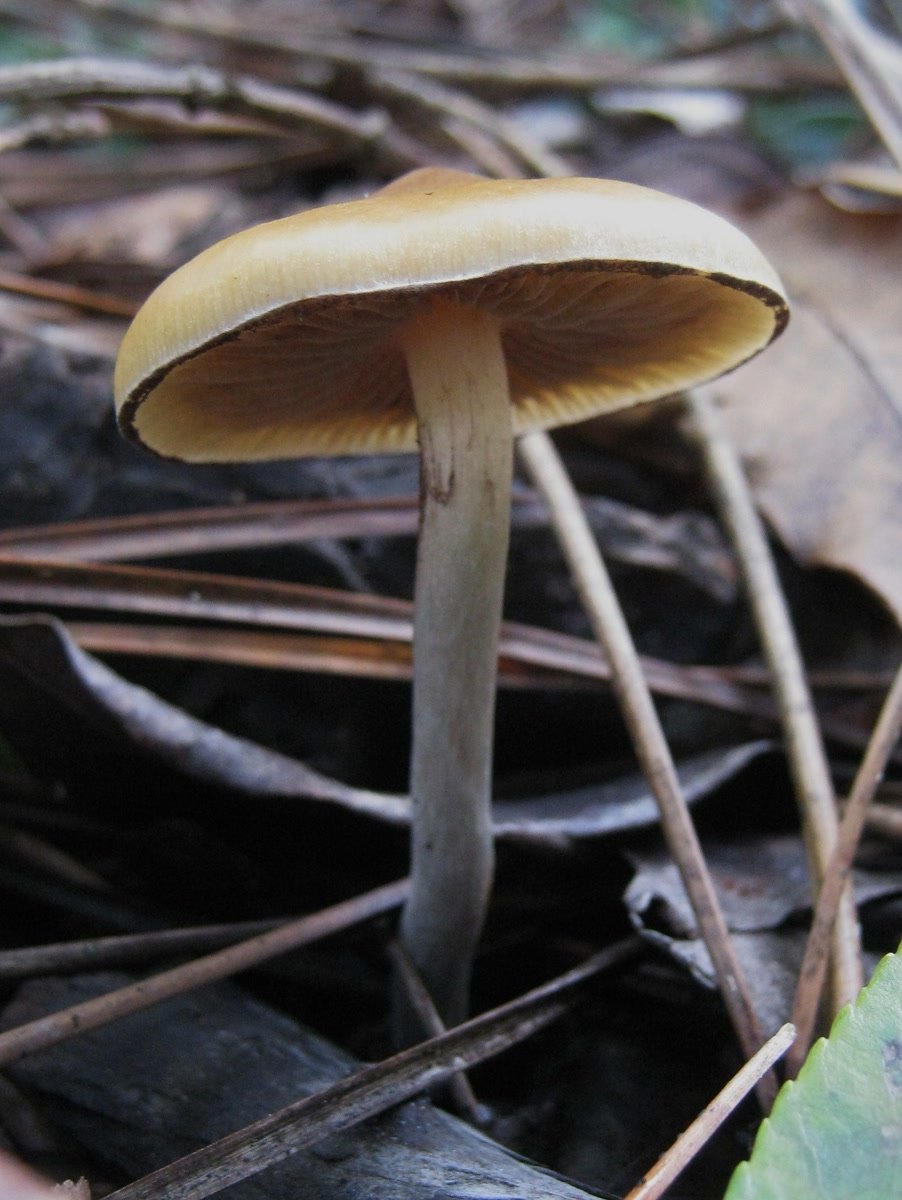
Psilocybin · Species
Psilocybe azurescens
Stamets & Gartz, 1996 · Flying Saucer, Azzies
'Flying Saucers' — among the most potent psilocybin mushrooms known, described from the Oregon coast by Paul Stamets and Jochen Gartz, growing on driftwood and dune-grass roots at the edge of the Pacific.
Identification, in outline
Psilocybe azurescens has a caramel to chestnut cap with a pronounced central umbo — the “flying saucer” profile — and stems that bruise a deep blue. It fruits in the cold months on coastal wood and dune grass. Like the other wood-lovers, it shares habitat with the deadly Galerina, and the same warning applies.
A coastal endemic, newly named
The species was described only in 1996, by the mycologist Paul Stamets and Jochen Gartz, from populations around the mouth of the Columbia River.1 Its natural range is strikingly small — a strip of the Oregon and Washington coast — even though cultivation has since carried it far beyond.
The most potent of all
P. azurescens is repeatedly reported as having the highest psilocybin and psilocin concentrations of any known mushroom. In the register of this archive that is not a recommendation but a caution: extreme, variable potency makes unsupervised use of wild material especially unpredictable and risky.
Toxicity, legality, and safety
The hazards are deadly lookalikes, exceptional and uneven potency, legal prohibition, and reports of temporary “wood-lover paralysis.” A cultural and historical record, not a guide to use.
Conservation
Naturally range-restricted but not threatened, and now widely propagated in cultivation.
Footnotes
-
Stamets & Gartz, described in Stamets, Psilocybin Mushrooms of the World (1996). ↩
The record
What remains uncertain
- Reported to contain the highest psilocybin concentrations of any species — which, if anything, makes wild self-administration more dangerous, not more desirable.
Sources & editorial record
Sources & further reading
Paul Stamets (1996). Psilocybin Mushrooms of the World: An Identification Guide. Ten Speed Press.
The best-known modern field guide to psilocybin species; widely used for identification and a key vehicle for popularising the group. A reference work, not a peer-reviewed study.
Jonathan Ott (1993). Pharmacotheon: Entheogenic Drugs, Their Plant Sources and History. Natural Products Co..
Encyclopaedic survey of entheogens; compiles obscure and historical mushroom cases, including the 17th-century Yurimagua mushroom inebriant reported from the Amazon.
Editorial record
Corrections history
No corrections recorded yet. Spotted an error or a mischaracterisation? See how corrections work.
Last reviewed
A cultural and historical record — not a foraging, cultivation, or consumption guide.