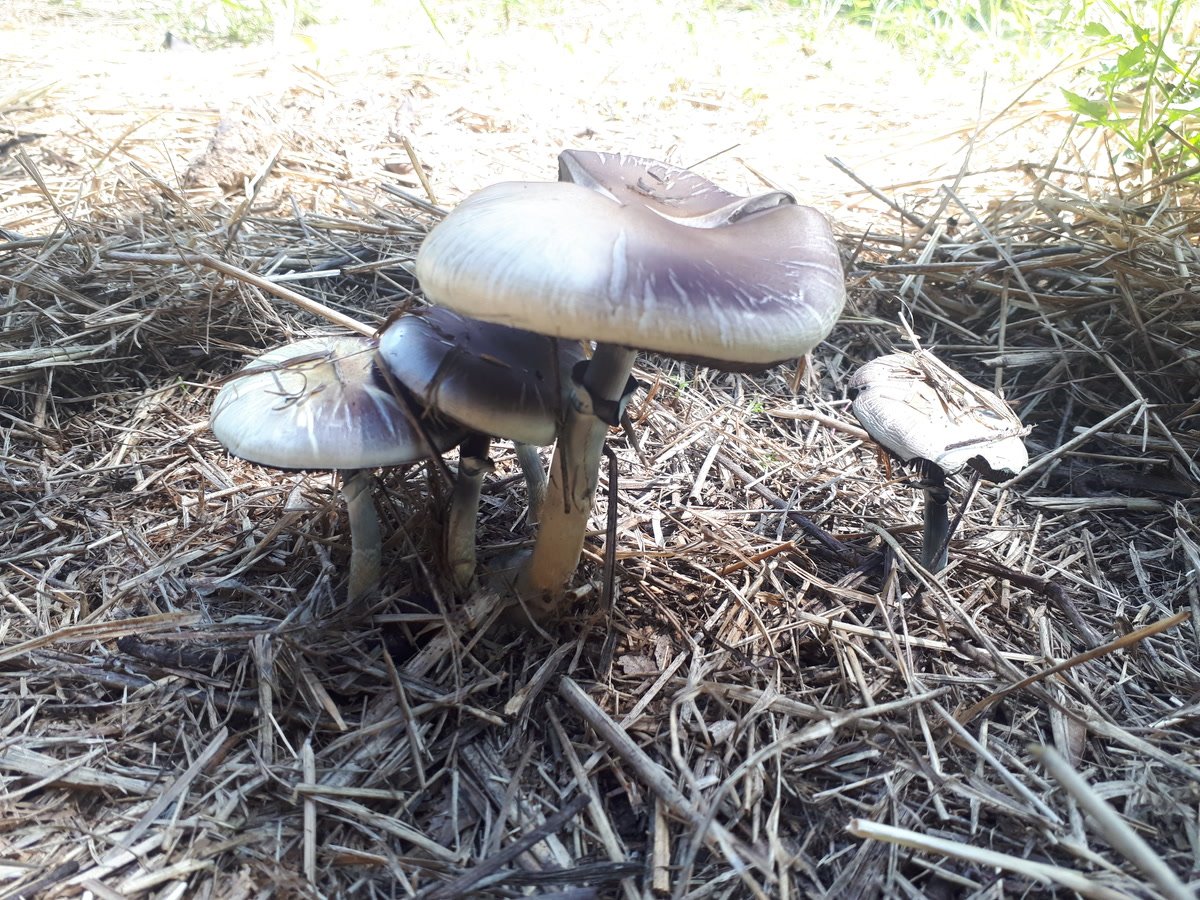
Psilocybin · Species
Psilocybe cubensis
(Earle) Singer, 1948 · San Isidro, Golden Teacher (a cultivated strain name)
The most widely known psilocybin mushroom on earth — a dung-loving, pantropical species that travelled the world with cattle, became the mainstay of cultivation, and enters some Mexican ceremonies as the hongo de San Isidro.
Identification, in outline
Psilocybe cubensis is a comparatively large, golden- to caramel-brown mushroom with a broad cap, a persistent ring on the stem, and — like its relatives — strong bluish bruising where handled. It grows directly from the dung of cattle and other grazers. As with all small-to-medium brown mushrooms, field identification carries real risk: the danger is misidentification, not some special malignancy of the species.
The mushroom that followed the cattle
More than any other, this is the species that made “magic mushrooms” a global idea. It is pantropical, thriving wherever cattle are pastured in warm, humid country, and its close association with introduced livestock means it may well have spread with ranching rather than growing in the Americas since antiquity.1 That matters for the cultural record: where P. cubensis enters Mexican ceremony, as the hongo de San Isidro, it appears to be a relatively recent addition rather than an ancient one.
The cultivated species
P. cubensis is also the mushroom of the modern psychedelic economy — the one behind the great majority of cultivation, and behind strain names like “Golden Teacher.” This archive documents that fact without providing any cultivation, dosing, or sourcing guidance: it is a cultural and historical record, not a how-to.
Active compounds
The principal actives are psilocybin and psilocin, with lesser baeocystin; concentrations vary widely between fruitbodies, strains, and growing conditions, which is one reason self-administration is unpredictable.
Toxicity, legality, and safety
Psilocybin mushrooms are not amatoxin-poisonous, but that is no reassurance: the real hazards are misidentification, the legal status of psilocybin (a controlled substance in Mexico and most countries),2 and the psychological risks of unsupervised use. This page is not a foraging guide.
Conservation
Abundant and expanding rather than threatened — one of the few species here under no conservation concern at all.
Footnotes
The record
Local names
| Name | Language | Translation / gloss |
|---|---|---|
| hongo de San Isidro | Spanish (Mexico) | mushroom of Saint Isidore the Ploughman — patron of the cattle whose dung it favours |
Indigenous- and local-language names appear in many spellings across dialects, publications, and orthographies. We record them as given in our sources and do not standardise them or invent translations. A dagger (†) marks a form our sources flag as uncertain.
What remains uncertain
- Because it follows cattle, P. cubensis may be a post-Columbian arrival in the Americas rather than an ancient sacred species — its ceremonial role as the 'hongo de San Isidro' looks comparatively recent.
Sources & editorial record
Sources & further reading
Gastón Guzmán (2008). Hallucinogenic Mushrooms in Mexico: An Overview. Economic Botany 62(3).
Species-level overview; identifies P. caerulescens (Nahua teotlaquilnanácatl) among ceremonially used mushrooms and counts Indigenous peoples with recorded use.
Paul Stamets (1996). Psilocybin Mushrooms of the World: An Identification Guide. Ten Speed Press.
The best-known modern field guide to psilocybin species; widely used for identification and a key vehicle for popularising the group. A reference work, not a peer-reviewed study.
Andy Letcher (2006). Shroom: A Cultural History of the Magic Mushroom. Faber & Faber.
A critical cultural history that deflates several popular entheogenic myths — useful precisely where it disagrees with the psychedelic canon.
Congreso de la Unión (current). Ley General de Salud (arts. 234, 245). Cámara de Diputados, Mexico.
Lists psilocybin and hallucinogenic mushrooms, including Psilocybe mexicana, as controlled substances.
Editorial record
Corrections history
No corrections recorded yet. Spotted an error or a mischaracterisation? See how corrections work.
Last reviewed
A cultural and historical record — not a foraging, cultivation, or consumption guide.