Psilocybin · Species
Psilocybe cyanescens
Wakef., 1946 · Wavy Caps
Wavy Caps — a potent, wood-loving psilocybe that has made a home in the woodchip and mulch of parks and gardens, spreading through the landscaped edges of cities across Europe and North America.
Identification, in outline
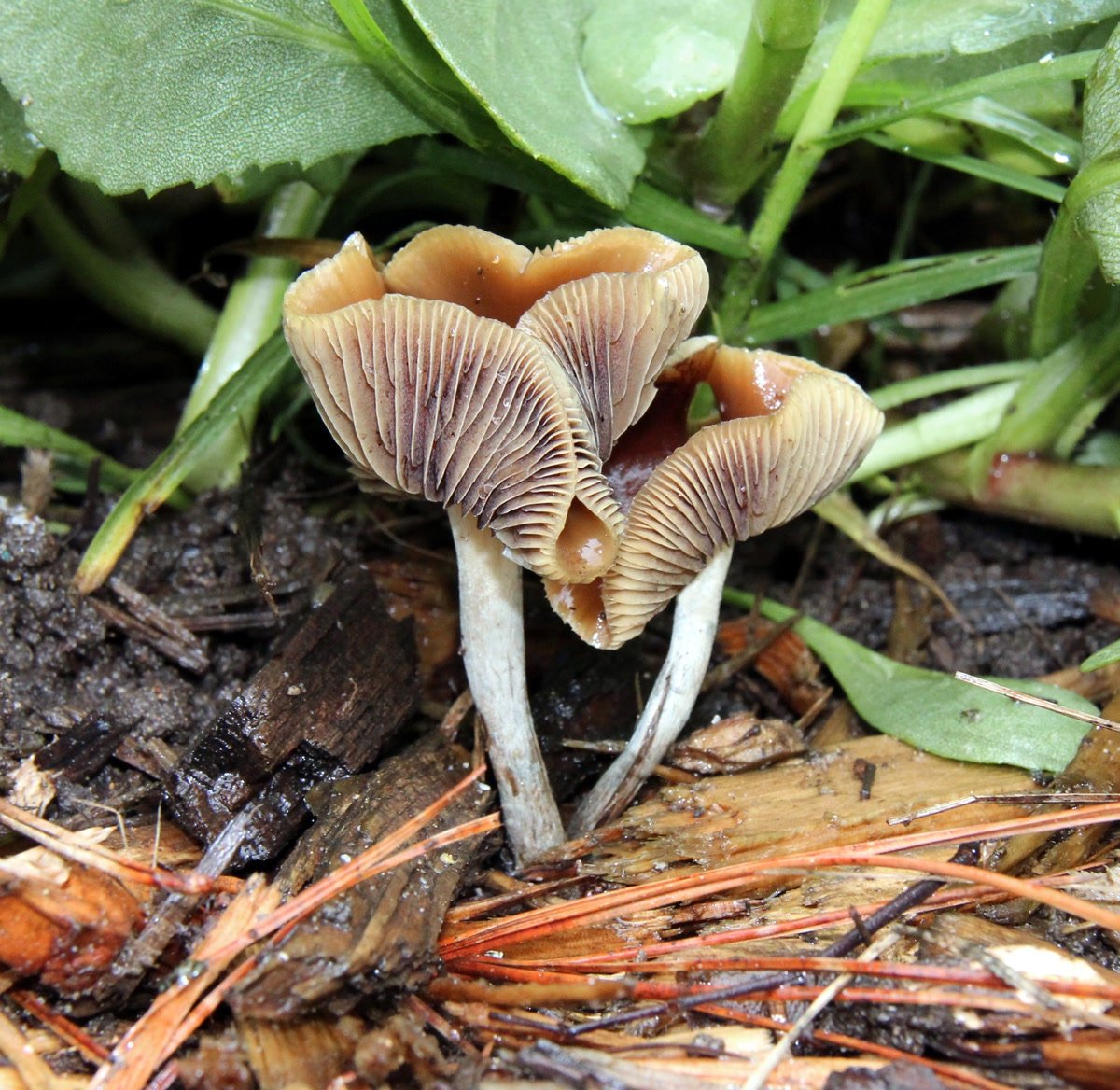
Psilocybe cyanescens takes its common name from the wavy, undulating margin of its caramel-brown, hygrophanous cap. It grows in dense clusters and bruises an intense blue-green where handled. The catch is severe: deadly Galerina marginata fruits on the same wood, in the same season, and can look confusingly similar — misidentification here can be fatal.
A mushroom of the human-made world
What makes P. cyanescens interesting culturally is its habitat: not ancient forest or sacred meadow, but woodchip and bark mulch. As municipal landscaping spread lignin-rich mulch through parks, verges, and gardens, the species spread with it, colonising a niche humans unintentionally created. It is a genuinely modern, urban mushroom.
Active compounds
The wood-loving psilocybes are among the most potent in the genus, rich in psilocybin and psilocin, with concentrations that swing widely between flushes — a large part of why wild material is so unpredictable.
Toxicity, legality, and safety
Beyond the deadly Galerina lookalike, the hazards are the familiar ones: high, variable potency; prohibition in most jurisdictions; and the reported phenomenon of temporary “wood-lover paralysis.” This page documents the species, not its use.
Conservation
Spreading rather than declining — its mulch habitat expands with every landscaped park — and of no conservation concern.
The record
What remains uncertain
- Potency in wood-loving Psilocybe is notably high and variable, which makes wild material especially unpredictable.
Sources & editorial record
Sources & further reading
Paul Stamets (1996). Psilocybin Mushrooms of the World: An Identification Guide. Ten Speed Press.
The best-known modern field guide to psilocybin species; widely used for identification and a key vehicle for popularising the group. A reference work, not a peer-reviewed study.
Jonathan Ott (1993). Pharmacotheon: Entheogenic Drugs, Their Plant Sources and History. Natural Products Co..
Encyclopaedic survey of entheogens; compiles obscure and historical mushroom cases, including the 17th-century Yurimagua mushroom inebriant reported from the Amazon.
Editorial record
Corrections history
No corrections recorded yet. Spotted an error or a mischaracterisation? See how corrections work.
Last reviewed
A cultural and historical record — not a foraging, cultivation, or consumption guide.