Psilocybin · Species
Psilocybe semilanceata
(Fr.) P. Kumm., 1871 · Liberty Cap, witch's hat
The Liberty Cap — the small, sharply pointed grassland mushroom that is the most common and potent wild psilocybe of Europe, and the centre of the modern European mushroom story rather than an ancient one.
Identification, in outline
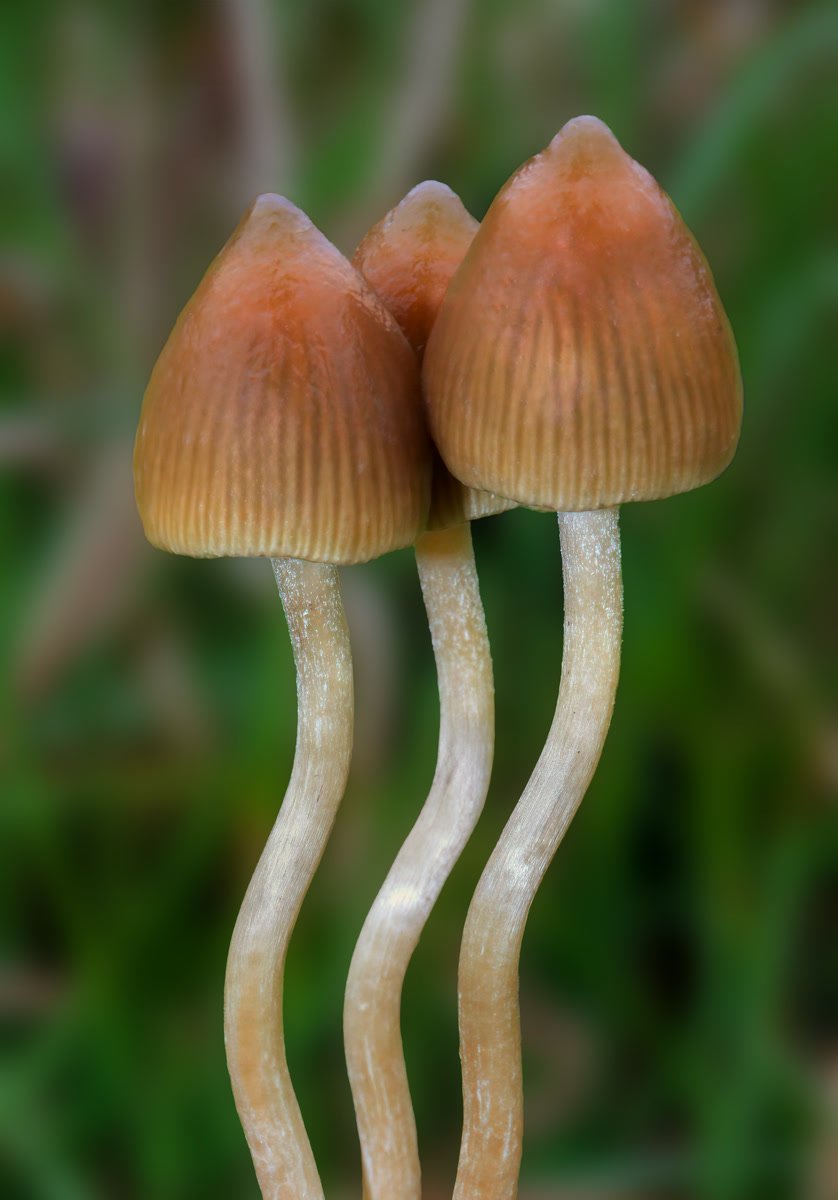
The Liberty Cap is among the few small psilocybes that is genuinely distinctive: a tall, thin stem carries a sharply conical, nippled cap — the “witch’s hat” — that is hygrophanous and often has a gelatinous, peelable skin. It bruises bluish at the stem base. Even so, deadly Galerina and other little brown mushrooms share its haunts, and identification is never trivial.
A grassland, not a dung, mushroom
Unlike P. cubensis, the Liberty Cap does not grow on dung but from the decaying roots of grasses, in unimproved pasture, meadow, and lawn, appearing with the autumn cool and damp. It is the classic wild psilocybe of the British Isles and northern Europe, and one of the most potent.
A surprisingly modern story
For all the talk of ancient European mushroom cults, the Liberty Cap’s documented history is recent. The first clear European account of psilocybe intoxication is from 1799, when a London family cooked wild mushrooms gathered in Green Park and experienced the effects.1 Genuine evidence for prehistoric European use is absent; the question is weighed, honestly, in the European prehistory debate.
Active compounds, toxicity, and law
The actives are psilocybin and baeocystin, at some of the highest concentrations of any wild species. The dangers are the usual ones — deadly lookalikes, unpredictable potency, legal prohibition across most of Europe, and the risks of unsupervised use. This is not a foraging guide.
Conservation
Widespread and not of conservation concern, though sensitive to the loss of old, unimproved grassland.
Footnotes
-
Letcher, Shroom (2006), on the 1799 London case and the modern origins of European mushroom culture. ↩
The record
What remains uncertain
- There is no reliable evidence of an ancient European tradition using this mushroom; the first clear record of intoxication is only 1799.
Sources & editorial record
Sources & further reading
Andy Letcher (2006). Shroom: A Cultural History of the Magic Mushroom. Faber & Faber.
A critical cultural history that deflates several popular entheogenic myths — useful precisely where it disagrees with the psychedelic canon.
Jonathan Ott (1993). Pharmacotheon: Entheogenic Drugs, Their Plant Sources and History. Natural Products Co..
Encyclopaedic survey of entheogens; compiles obscure and historical mushroom cases, including the 17th-century Yurimagua mushroom inebriant reported from the Amazon.
Editorial record
Corrections history
No corrections recorded yet. Spotted an error or a mischaracterisation? See how corrections work.
Last reviewed
A cultural and historical record — not a foraging, cultivation, or consumption guide.