Psilocybin · Species
Psilocybe tampanensis
Guzmán & S.H. Pollock, 1978 · Philosopher's Stone, magic truffle (of the sclerotia)
The 'Philosopher's Stone' — a rare Florida psilocybe famous less for its mushroom than for its sclerotia: the hardened underground masses, sold legally in the Netherlands as 'magic truffles', that exploit a gap between mushroom and fungus in the law.
A mushroom known by its underground body
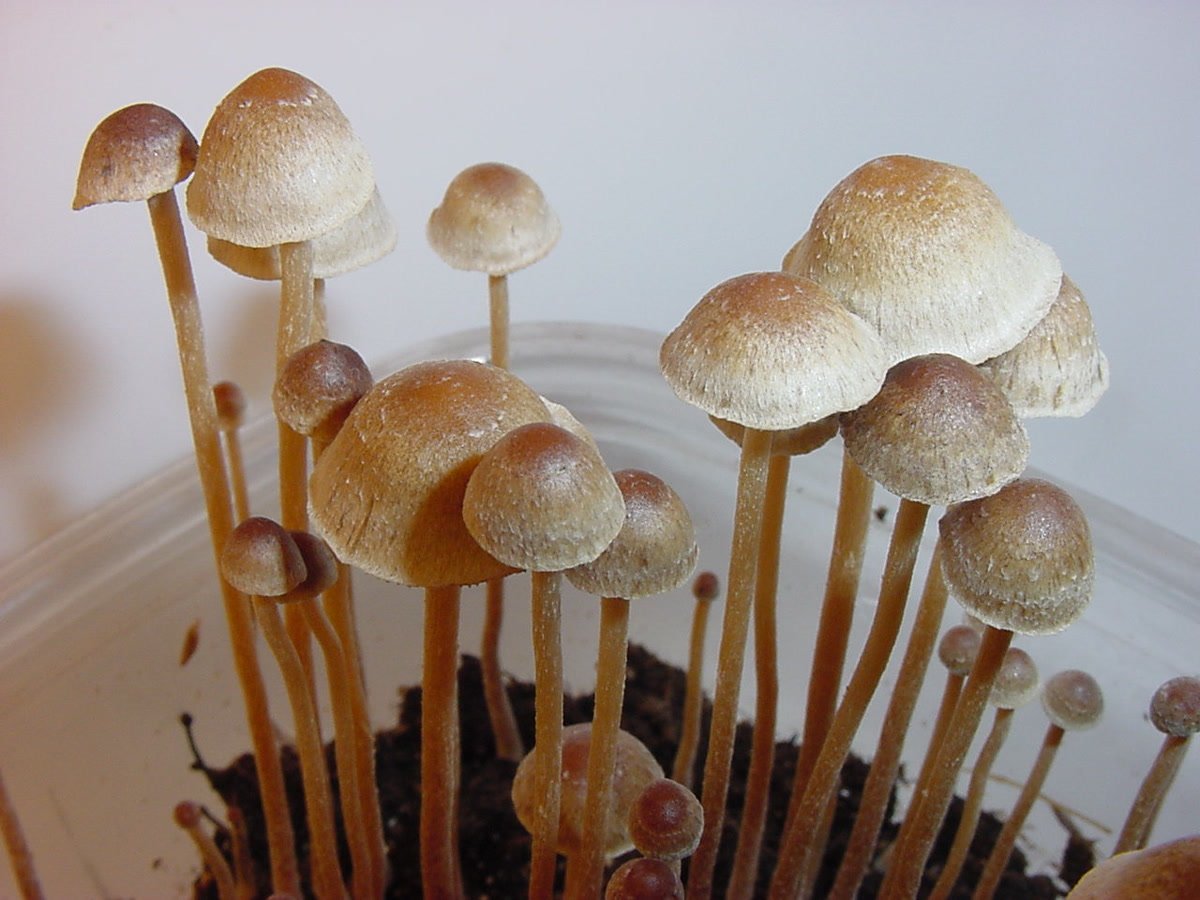
Psilocybe tampanensis is an unremarkable-looking small tan mushroom — but it is famous for what it does below ground. Under stress it forms sclerotia: hard, compact masses of fungal tissue, containing psilocybin, that can survive drought and fire. These are the “magic truffles” of the trade, and they are why the species is known at all.
The truffle in the legal gap
Because some drug laws name the mushroom (the fruiting body) rather than the whole fungus, the sclerotia of P. tampanensis fall, in the Netherlands, into a legal gap — and are sold there as “truffles” where cultivated mushrooms are banned.1 The archive records this as a fact about the law’s odd seams, not as a recommendation: a jurisdictional loophole is not a safety guarantee.
A near-mythical rarity
Found in the wild only a handful of times since its 1978 description near Tampa, Florida, the species survives in the world almost entirely as cultivated stock.2 Its nickname, the “Philosopher’s Stone,” suits a mushroom better known as an idea than as a wild organism.
Active compounds, toxicity, and law
The actives are psilocybin and psilocin, in both mushroom and sclerotia. The hazards and legal cautions are those of every psilocybin fungus; this page documents, and does not instruct.
Conservation
Vanishingly rare in the wild, but in no danger of extinction thanks to cultivation.
Footnotes
The record
What remains uncertain
- The species is so rarely found in the wild that almost everything known about it comes from cultivated material descended from a few collections.
Sources & editorial record
Sources & further reading
Gastón Guzmán (2008). Hallucinogenic Mushrooms in Mexico: An Overview. Economic Botany 62(3).
Species-level overview; identifies P. caerulescens (Nahua teotlaquilnanácatl) among ceremonially used mushrooms and counts Indigenous peoples with recorded use.
Jonathan Ott (1993). Pharmacotheon: Entheogenic Drugs, Their Plant Sources and History. Natural Products Co..
Encyclopaedic survey of entheogens; compiles obscure and historical mushroom cases, including the 17th-century Yurimagua mushroom inebriant reported from the Amazon.
Editorial record
Corrections history
No corrections recorded yet. Spotted an error or a mischaracterisation? See how corrections work.
Last reviewed
A cultural and historical record — not a foraging, cultivation, or consumption guide.