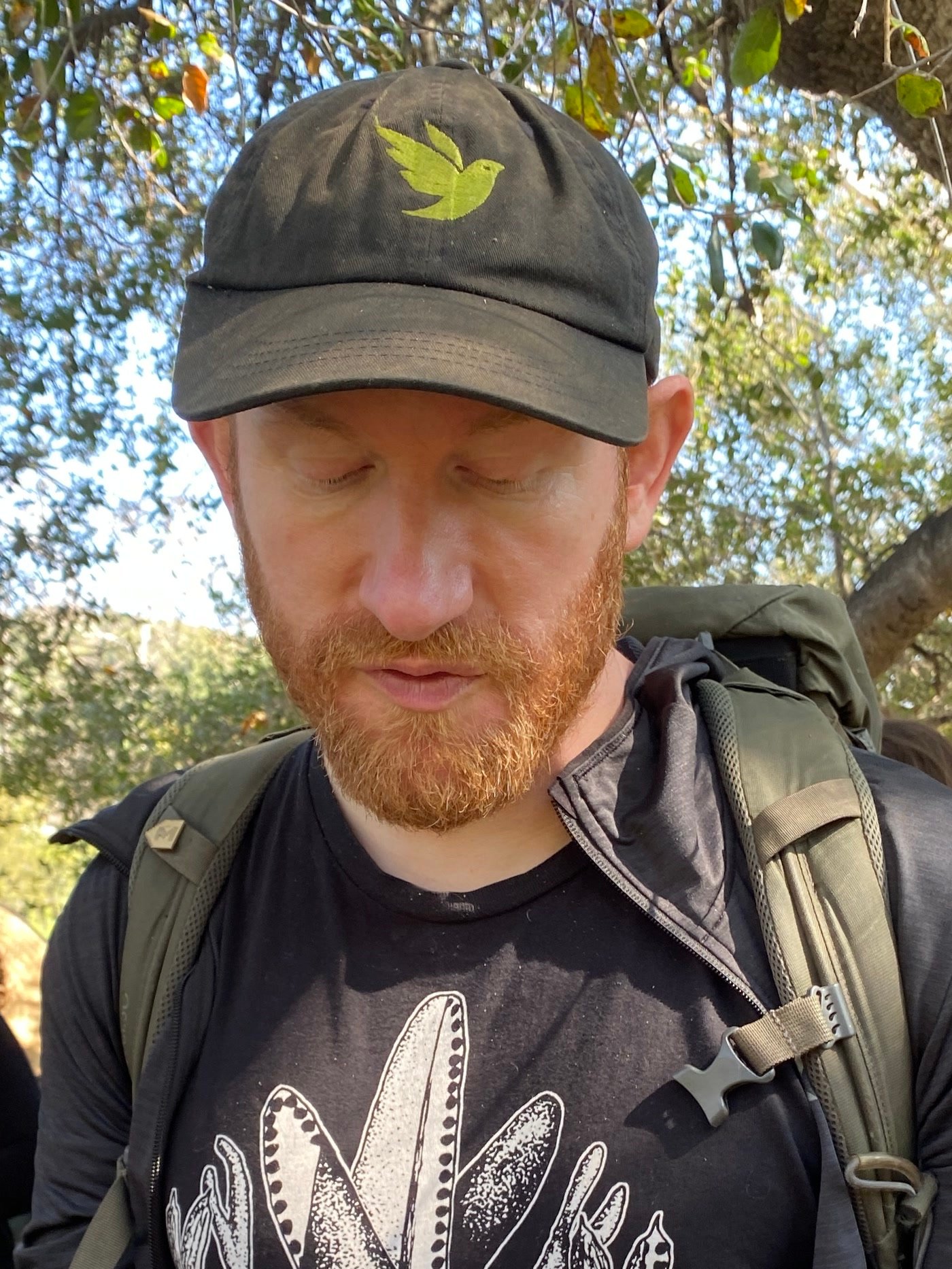
Researcher
Alan Rockefeller
Mycologist, DNA barcoder & mushroom photographer · b. c. 1980
One of the most recognisable Psilocybe experts alive — a self-taught mycologist who pairs old-school microscopy with DNA barcoding, has photographed thousands of species, and helped put a new African psilocybin mushroom on the scientific map.
The barcoder
Alan Rockefeller is what a mycologist looks like in the age of cheap sequencing: a self-taught field expert who carries a microscope and a mind full of Latin binomials, and who has personally uploaded hundreds of fungal DNA sequences to public databases. National Geographic has called him one of the best-known mycologists working on Psilocybe, and his photographs — sharp, unmistakable — illustrate species pages across the internet, including several on this site.
Self-taught, at scale
Rockefeller’s path ran outside the university. He began chasing fungi in Baja California around 2001 and never stopped: from his base near San Francisco he has photographed more than three thousand species, uploaded hundreds of DNA barcodes to public gene banks such as GenBank, and for years helped moderate the largest online community of mushroom enthusiasts.1 That combination — obsessive field collecting, a good microscope, and now cheap sequencing — is exactly what has let a self-taught outsider keep naming species the academy walked past. It is also a quiet argument the archive likes: that serious knowledge of these mushrooms has never belonged only to institutions.
New species, new continents
Rockefeller’s barcoding work keeps redrawing the map. He was a co-author on the 2024 description of two southern African species, Psilocybe maluti and P. ingeli — the first strong published evidence of a traditional psilocybin-mushroom practice in Africa — and on the naming of Psilocybe stametsii from Ecuador.23 He is proof that the frontier of the mushroom story is not the distant past but the present tense.
Footnotes
-
Profile and figures drawn from National Geographic coverage and Rockefeller’s public collecting and sequencing record. ↩
-
van der Merwe et al., “A description of two novel Psilocybe species from southern Africa,” Mycologia (2024). ↩
-
Psilocybe stametsii sp. nov., Los Cedros, Ecuador (announced 2023). ↩
The record
Sources & editorial record
Sources & further reading
Breyten van der Merwe et al. (2024). A description of two novel Psilocybe species from southern Africa and some notes on African traditional hallucinogenic mushroom use. Mycologia 116(5).
Formally describes two native southern African species — Psilocybe maluti and Psilocybe ingeli — and reports Basotho traditional use of P. maluti, co-authored with the traditional healer Mamosebetsi Sethathi. The first strong published African case.
Bryn T. Dentinger et al. (2023). Psilocybe stametsii sp. nov. — a new species from the Los Cedros cloud forest, Ecuador. Fungi Foundation / Natural History Museum of Utah.
Describes a tiny Andean Psilocybe named in Stamets’ honour, collected by Dentinger (2011) and Furci (2022) — the same Utah mycology group behind the Lanmaoa work.
Editorial record
Corrections history
No corrections recorded yet. Spotted an error or a mischaracterisation? See how corrections work.
Last reviewed