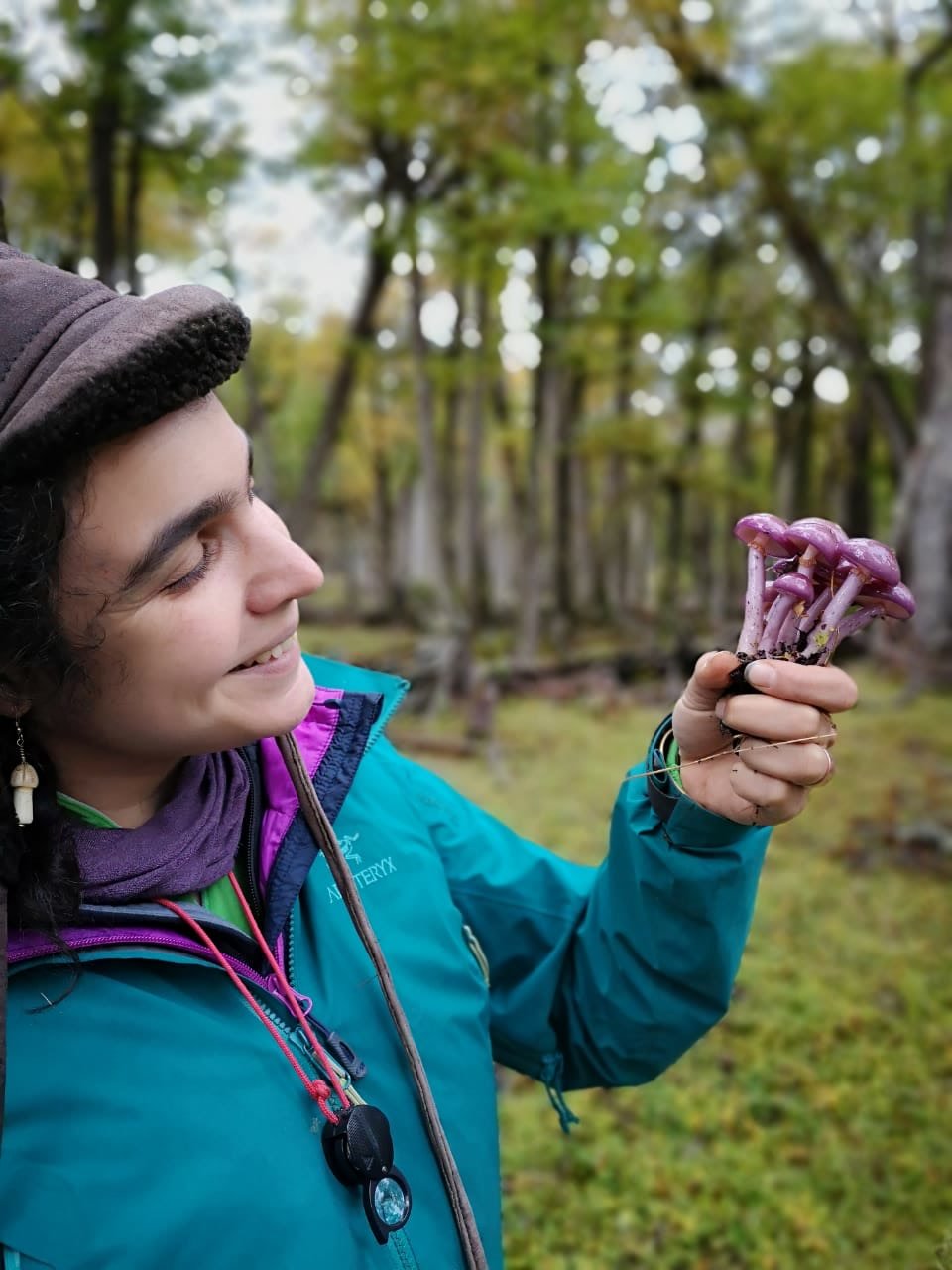
Researcher
Giuliana Furci
Field mycologist & founder of the Fungi Foundation · b. 1978
The self-taught Chilean mycologist who built the world's first NGO dedicated to fungi, pushed 'funga' into law and language, and helped describe the tiny Andean mushroom named for Paul Stamets.
When we talk about flora and fauna, we must also talk about funga.
A kingdom with a champion
Giuliana Furci taught herself mycology in Chile because there was nowhere to study it — then spent two decades making sure the next person wouldn’t have to. In 2012 she founded the Fungi Foundation, the first NGO in the world devoted to fungi, and her advocacy helped write fungi into Chilean environmental law and into the global vocabulary through the Fauna, Flora & Funga proposal: the simple, radical insistence that fungi are a kingdom of their own, not an afterthought to plants.
Writing fungi into the law
Furci wrote Chile’s first field guides to its own fungi — books that simply had not existed — and turned that fieldwork into policy. Largely through her advocacy, Chile became the first country in the world to require that fungi be considered in environmental impact assessments, giving mushrooms legal standing alongside plants and animals. Her Fauna, Flora & Funga campaign has since been taken up internationally, changing how conservation bodies write the word for life itself. It is a rare thing: a mycologist who moved the mushroom from the footnotes of biology into statute.
Into the cloud forest
A National Geographic Explorer and Harvard associate, Furci is also a working field mycologist. She helped describe several new species — including Psilocybe stametsii, the minuscule Andean psilocybin mushroom collected in Ecuador’s Los Cedros cloud forest and named in Stamets’s honour.1 Her career is a reminder that the story of the sacred mushroom is still being written, in the field, right now — increasingly by voices from outside the old Western academy.
Footnotes
-
Psilocybe stametsii sp. nov., Los Cedros, Ecuador (announced 2023). ↩
The record
Sources & editorial record
Sources & further reading
Giuliana Furci & and colleagues (2018). State of the World’s Fungi / the "Funga" and Fauna–Flora–Funga (3F) proposal. Royal Botanic Gardens, Kew / Fungi Foundation.
Furci’s conservation work establishing fungi as a distinct kingdom deserving legal and ecological protection.
Bryn T. Dentinger et al. (2023). Psilocybe stametsii sp. nov. — a new species from the Los Cedros cloud forest, Ecuador. Fungi Foundation / Natural History Museum of Utah.
Describes a tiny Andean Psilocybe named in Stamets’ honour, collected by Dentinger (2011) and Furci (2022) — the same Utah mycology group behind the Lanmaoa work.
Editorial record
Corrections history
No corrections recorded yet. Spotted an error or a mischaracterisation? See how corrections work.
Last reviewed