Other · Species
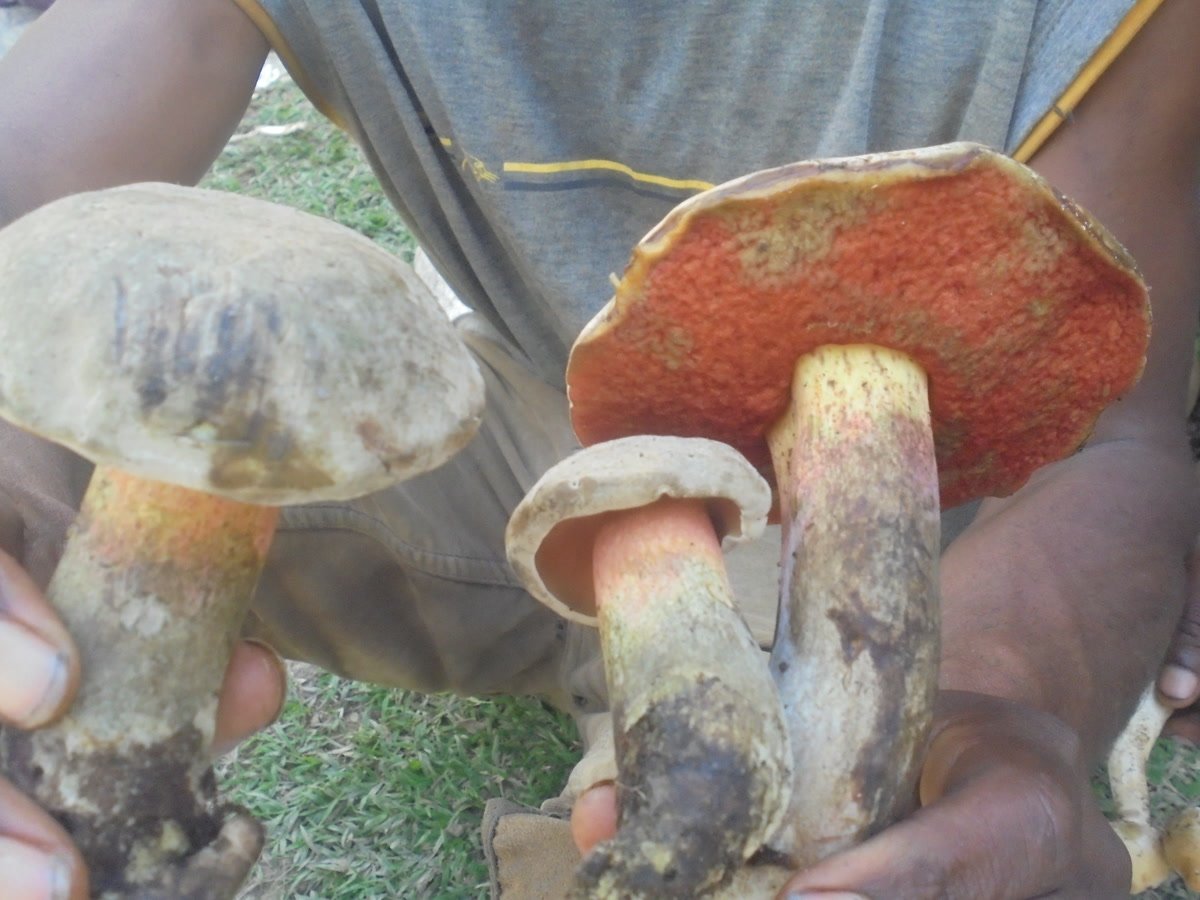
Boletus manicus
Heim, 1965 · nonda (a name applied broadly to several boletes)
The vivid bolete at the centre of the New Guinea 'mushroom madness' — identified by Roger Heim among the Kuma of the Wahgi Valley, and famous precisely because the psychoactivity attributed to it was never confirmed.
The mushroom of the “madness”
Boletus manicus is a bolete of the New Guinea Highlands, collected among the Kuma of the Wahgi Valley and named by the mycologist Roger Heim in 1965. It is one of the several mushrooms the Kuma call nonda, and in Wahgi it carries the blunt name gegwantsyi ngimbl — “the painful one,” for a bitterness described as almost unbearable.1
Identified, but never explained
The mushroom is famous because of what it was said to do: the seasonal komugl tai, the “mushroom madness,” in which people ate certain mushrooms and behaved wildly. Heim reported unusual indole compounds in B. manicus and suspected a psychoactive role — but no one has ever confirmed a compound, or a dose, that would actually produce the effect.1 The pharmacology simply hasn’t materialised.
Why it is rated disputed
This is the archive’s clearest case of a “sacred” or “intoxicating” mushroom that may not be a drug at all. The best current reading is that the Wahgi “madness” was a culturally patterned performance attributed to the mushroom rather than caused by it. The species is real; its psychoactivity is unproven. The story is told in full on the Kuma page.
Toxicity and safety
Not established as psychoactive, and — beyond its extreme bitterness — not well characterised toxicologically. Nothing here should be read as an invitation to test it.
Conservation
A wild montane bolete of restricted range; not assessed, and of no known conservation concern.
Footnotes
The record
Local names
| Name | Language | Translation / gloss |
|---|---|---|
| gegwantsyi ngimbl † | Wahgi | the bitter/painful one (ngimbl = pain) |
Indigenous- and local-language names appear in many spellings across dialects, publications, and orthographies. We record them as given in our sources and do not standardise them or invent translations. A dagger (†) marks a form our sources flag as uncertain.
What remains uncertain
- No compound has ever been confirmed that would explain the behaviour attributed to this mushroom.
Sources & editorial record
Sources & further reading
Roger Heim & R. Gordon Wasson (1965). La folie des Kuma: le champignon nonda et Boletus manicus. Cahiers du Pacifique.
Heim and Wasson investigate the New Guinea "mushroom madness," identifying nonda boletes (including Boletus manicus) without isolating a compound that explains the reported effects.
Marie Reay (1960). Mushroom madness in the New Guinea Highlands. Oceania 31(2): 137–139.
Classic ethnographic report of "komugl tai" / nonda-associated behaviour among the Kuma of the Wahgi Valley, Papua New Guinea — the anthropological origin of the puzzle.
Jonathan Ott (1993). Pharmacotheon: Entheogenic Drugs, Their Plant Sources and History. Natural Products Co..
Encyclopaedic survey of entheogens; compiles obscure and historical mushroom cases, including the 17th-century Yurimagua mushroom inebriant reported from the Amazon.
Editorial record
Corrections history
No corrections recorded yet. Spotted an error or a mischaracterisation? See how corrections work.
Last reviewed
A cultural and historical record — not a foraging, cultivation, or consumption guide.